Μῆνιν ἄειδε θεὰ Πηληϊάδεω Ἀχιλῆος — Sing, goddess, the wrath of Achilles, son of Peleus. A voice invokes a goddess to sing of a hero. The divine sings through the bard the wrath of a demigod before the walls of Troy. The bard is a singer, not a poet.
A few centuries later, in Rome, a young woman named Sulpicia would write to her lover that she had a fever, and that she wished her lover would worry about it. Between these two voices, song has become poem and the bard has become a poet. The chant has given way to making (ποιεῖν = poiein = to make). The voices have left Olympus to enter the bedroom.
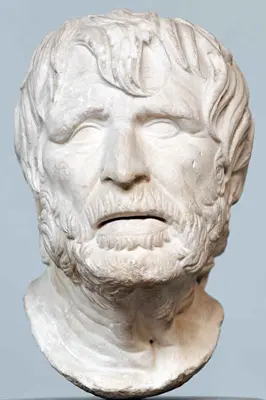
Homer: the voice without a face
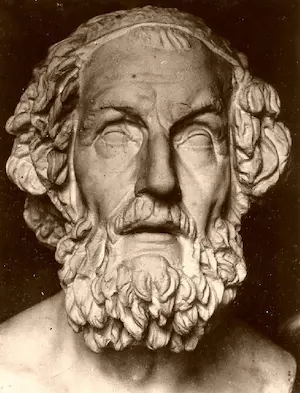
We do not know if he was one man or several bards, whether he was blind, where he lived. And this indeterminacy is consistent with what the Iliad and the Odyssey are: collective songs, transmitted orally from generation to generation, sustained by recurring formulas — rosy-fingered dawn, swift-footed Achilles — that help the bard improvise without ever straying from the thread.
The poem belongs to no one in particular. It belongs to the community that recognizes it. The poet, for his part, is interchangeable. He lends his voice to a goddess, to a Muse, to a tradition that exceeds him. When he says sing, he addresses a power that speaks through him. He is not the author of the song — he is its passer.
Hesiod: the first signature
The first crack comes very quickly. In the Theogony, Hesiod recounts his own encounter with the Muses: he was a shepherd on the slopes of Helicon, they appeared to him, gave him a laurel branch, and taught him song. And he names himself: Ἡσίοδος. This is, as far as we know, the first time in Greek literature that a poet inscribes himself in his own poem.
The poet ceases to be anonymous. He writes his name in the text. The poem still retains a sung and collective function — Hesiod transmits a cosmogony and organizes divine genealogies. Independence is, however, incomplete. Hesiod names himself, certainly, but he must begin each poem by invoking the Muses. The poiein has begun — someone makes — but the song remains, formally, a gift from the goddesses. The poet exists; his speech does not yet belong to him.
In Works and Days, Hesiod explains to his brother, Perses, how to work the land properly. We are far from any dolce vita or carpe diem: for Hesiod, you must work, work, and work: "If an idle man looks at a rich one, he hurries to plough, to plant, to govern his house well," or again: "One should give little attention to lawsuits and the agora when one has not gathered in one's house, during the season, the food, gift of Demeter." Always work, always work, for Hesiod. And why? Because his brother is trying to grab part of his inheritance, so he writes this whole long didactic poem to explain to him that it is still better to earn one's living honestly than through scheming. He also gives other details about his life: his father was an economic migrant (having left Asia Minor for Greece): "He was not fleeing wealth or riches, but the wicked poverty that Zeus inflicts on men. And he settled, near Helicon, in the wretched village of Askra, terrible in winter, painful in summer, and never pleasant." He does not like sailing. He takes a boat just once, to take part in a poetry contest, which he wins. The bard Hesiod begins to anchor poetry in the real.
Sappho and Erinna: the individual voice
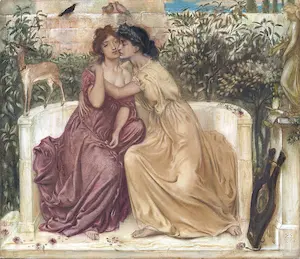
On Lesbos, in the 7th century BCE, Sappho sings accompanied by her lyre. She names the women she loves — Anactoria, Atthis — and describes her own body, her desires, and her torments. For Atthis, she describes her melancholy and the pain of the beloved's departure for a marriage. Before Anactoria, she becomes jealous, fragile, mortal — when the one lucky enough to be near Anactoria is transformed into a god: "He seems to me equal to the gods, that man who sits in your presence and hears from close by your sweet speech and your lovely laughter, which make my heart beat in the depths of my chest."
The subject of the poem is no longer a war or a hero. It is what a particular woman feels, at a particular moment, looking at another particular woman.
Later, Erinna of Telos will take up this torch of the intimate "I". But for her, the vertigo is no longer that of desire facing Anactoria; it is that of loss. In her poem The Distaff, the "I" becomes memory: she calls out to her departed friend, Baucis, and brings back to life their childhood games and their little-girl fears. Erinna shows that poetry can also be a refuge against the time that devours childhood friends.
Sappho sings. Erinna too. Their voices are intimate, their names inscribed in their verses — but the lyre is still there, and the audience. The decisive step — the one that will move the poem from voice to page — will not happen in Greece. It will happen in Rome.
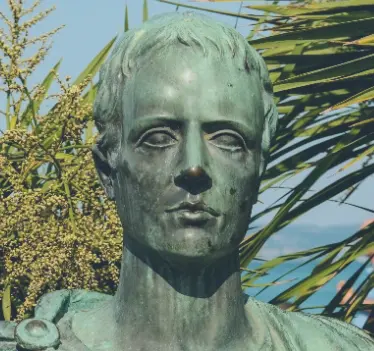
Catullus, Tibullus, Sulpicia, Horace: the written bedroom
Almost 500 years later, in the 1st century BCE, three things change at once.
First, the medium. Catullus writes to his mistress as one writes a letter: Let us live and let us love, my Lesbia. The poem is no longer sung; it is copied onto papyrus scrolls, sent, read alone — under one's breath, or silently. It becomes a material object that circulates, and that can reach a single person: the beloved.
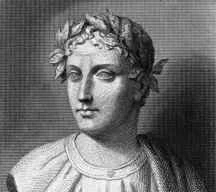
Next, the subject. The Trojan War gives way to a dead sparrow, a sleepless night, a fever. Catullus deems Lesbia's tiny grief worthy of a poem. Tibullus describes a night spent waiting for Delia. Horace, in Ode I.11 to Leuconoe, murmurs: While we speak, envious time flees. Seize the day and do not trust tomorrow.
The gods do not entirely disappear — Venus and Cupid still pass through the verses — but they have become ornaments.
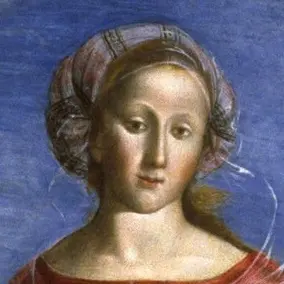
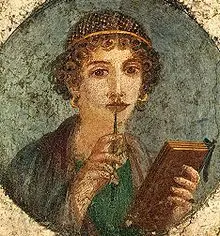
And then, the addressee. Sulpicia, one of the very rare Roman women poets whose verses have come down to us, writes to Cerinthus: "Do you, Cerinthus, feel some tender concern for the health of your beloved, while a burning fever torments her weary limbs?" Each poem carries a proper name in filigree, an identifiable addressee — loved, betrayed, or mocked. The poem becomes letter, seduction, vengeance, gossip — the intimate chronicle of a great city, but addressed to one heart at a time.
The audience disappears, then. And in becoming a letter, one can more easily picture the poet sitting at his table, working. The poiein theorized by the Greeks finds in Rome its concrete scene: a table, a lamp, a papyrus, and the name of someone to whom one writes. Where Hesiod, in order to sing as a bard, had to pay his tribute to the Muses, the Roman poet writes directly to his lover, to his mistress, to his friend.
Inspiration no longer descends from above. It stands across from us, in the bedroom, beneath the face of a beloved. Sappho had already opened this door: the man sitting before Anactoria became equal to the gods because he was before her and could hear her. The sacred had shifted — it had left Olympus to inhabit the presence of the beloved. The Romans complete this displacement. The Muse changes face: she is now the one to whom one writes.
The independence of the poet, denied to Hesiod, opened by Sappho, seems at last to be won in Rome.
But already, power is seizing the poets. The emperor, having become a man-god, commissions Virgil and Horace to write the official narrative of Rome and to spread it to the people and to eternity. Independence is therefore still far away. And seven hundred years after Homer, Virgil, in the Aeneid, will transform the figure of the hero — but that will be the subject of another article.
A divine legitimacy
At the start, this article was meant to be a simple comparison between Homer and Hesiod — the epic and the didactic poem. But as the readings and research progressed, another thread imposed itself: that of a slow conquest of the poet's freedom that never quite completes itself. The Muses never leave. The pact, certainly, is less "contractual" than with Hesiod: glorify the Muses at the start of each chant in order to keep receiving poetic inspiration, and with it the legitimacy to declaim. It is as if they were saying: if you say "I", then you must be legitimate.
These addressees, on the other hand, have not changed much: we write to continue the collective narrative, or to construct a new one. To glorify or accuse the gods, a God. To be on the right side of power. For the loved one who will worry about our fever. For our ego. For applause. For a friend, for a brother who is trying to swindle us, for an editor…
Hesiod gave himself this legitimacy. Until proven otherwise, we can be fairly certain that he did not actually see Muses descending from the sky to hand him a laurel branch. But the fact that he placed himself within a divine legitimacy gave him this permission. But if we strip away this cosmic apparatus? It was surely no more than an organic need, a force he did not understand himself, that pushed him to say to himself "I write".
Engraved in marble, copied onto a papyrus scroll, sung to a lyre before a circle — slammed in a bar, traced with a pen on an inked page, or typed in pixels on a screen. Someone takes the time to make a poem, with their own strength, their own calling. And someone else, somewhere, waits to read or hear that text.